AI Edge for Freelancers: Stand Out, Work Faster, Earn More
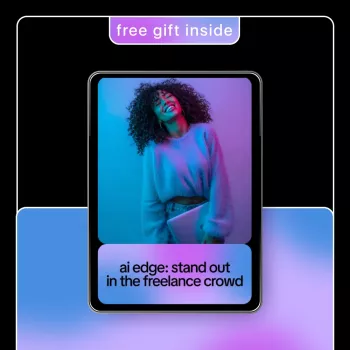
AI Edge: A Practical Playbook for Creators to Stand Out in a Crowded Freelance Market
Freelance competition is intense, and clients move fast. The advantage comes from clearer positioning, faster turnaround, stronger proof of value, and a consistent pipeline—without burning out. AI can help, but only when it’s paired with a real offer, a repeatable workflow, and a quality standard that doesn’t slip. Below is a practical system creators can use to sharpen skills, improve visibility, and raise income with repeatable routines.
Why Freelancers Blend In (and What Actually Makes Clients Choose You)
Most portfolios get ignored for predictable reasons: generic service lists (“design, video, copy”), unclear outcomes (“modern refresh”), inconsistent quality, and slow or scattered communication. When clients can’t quickly connect your work to their problem, they move on.
What clients reward is simpler than it looks:
- Specificity: one clear use case with a recognizable “before → after.”
- Reliability: a process clients can trust (and a deadline you consistently hit).
- Measurable impact: time saved, higher conversions, better retention, stronger engagement, fewer revisions.
A helpful differentiator stack to build toward is: niche + signature offer + proof + responsive workflow. AI supports every layer, but the stack itself is what makes you memorable.
Set Up an “AI Edge” Offer: Turn Skills Into a Productized Service
Productized services make it easier for clients to buy and easier for you to deliver. Start by picking one audience and one outcome. Examples:
- “Short-form video scripts that improve watch time and saves.”
- “Newsletter refresh that increases click-through and reduces unsubscribes.”
- “Landing page rewrite that clarifies the offer and lifts sign-ups.”
Next, define deliverables and boundaries so AI speeds work instead of expanding scope. If your offer includes “strategy,” be explicit about what strategy means in your package (audit notes, messaging angles, a content outline)—and what it doesn’t mean (endless Slack access, unlimited ideation, redesigns).
Use three tiers (starter, standard, premium) to guide budgets upward without pressure, and add a lightweight guarantee tied to process (two rounds of revisions, 48-hour first draft, or a kickoff call within 24 hours) rather than promising impossible results.
Productized offer builder (creator-focused)
| Offer element | What to decide | AI can help with |
|---|---|---|
| Target client | Industry + role + where they hang out | Persona drafts, pain-point research, message mapping |
| Outcome | One measurable transformation | Outcome statements, before/after positioning options |
| Deliverables | Exactly what’s included | Templates, checklists, draft variations |
| Turnaround | A realistic timeline you can repeat | Workflow steps, task breakdowns, time estimates |
| Proof | Portfolio pieces + mini case studies | Case study outlines, metrics story framing |
| Pricing | Tiered packages + add-ons | Value-based pricing hypotheses, tier comparison copy |
Build a Portfolio That Sells Outcomes (Not Just Aesthetic)
Beautiful work helps, but “gallery-only” portfolios don’t answer the question clients care about: “Will this solve my problem?” Replace endless grids with 3–6 focused case studies, each tied to a real business goal.
Use a consistent structure so scanning is effortless:
- Context: who the client is and what they needed.
- Constraints: timeline, brand rules, data limitations, approvals.
- Approach: what you considered and why you chose your direction.
- Deliverables: what you shipped (exactly).
- Results: metrics, outcomes, or a clear proxy (time saved, fewer edits, stronger clarity).
- What’s next: iteration plan, testing ideas, or recommended follow-on work.
AI is especially useful for turning scattered notes into clean narratives and for generating alternative headlines, hooks, or layout options—but your portfolio should highlight your decision-making. That’s the part most competitors don’t show.
If client work is limited, create “spec-to-real” samples: pick a real brand, set constraints (word count, audience, channel, brand voice), and document your reasoning. Clients hire confidence, not just credentials.
Visibility Systems That Don’t Depend on Going Viral
Going viral is optional. Consistency wins. Choose one primary channel and one support channel (for example: LinkedIn + email, or TikTok + a portfolio site). Make the system light enough that it survives busy weeks.
Turn real client questions into reusable content:
Win More Projects With a Faster, Cleaner Client Workflow
Raise Rates Without Losing Clients: Value, Positioning, and Proof
Ethical Use: Quality, Confidentiality, and Client Trust
AI adoption is accelerating because the productivity upside is real (see research on the future of work from Upwork and broader economic analysis from McKinsey). But trust is your differentiator, so set clear boundaries:
- Never paste sensitive client data, passwords, unreleased financials, or proprietary documents into tools.
- Disclose AI use when it affects deliverables or rights (especially for voice, likeness, or copyrighted inputs).
- Keep a “human final pass” standard: verify facts, align to brand voice, remove generic filler.
- Stay aligned with truthful advertising expectations (reference: U.S. Federal Trade Commission guidance).
Digital Downloads for Creators Building Consistency
If you want a structured, step-by-step system for packaging your services, tightening your workflow, and presenting proof in a way clients understand, explore AI Edge: Stand Out in the Freelance Crowd (digital download).
To support the focus and follow-through that makes any system work, pair it with Unlock the Page: a simple reading habit guide—a lightweight way to strengthen attention, learning, and creative stamina.
FAQ
Can AI help a freelancer stand out without making the work feel generic?
Yes—use AI for structure, options, research, and speed, then apply your taste and strategy in the final decisions. A strict editing pass plus clear positioning and outcome-driven case studies keeps the work distinctive and credible.
What’s the fastest way to turn AI into more freelance income?
Productize one offer, shorten turnaround, and improve proposal clarity so clients can buy faster. Then add small, outcome-aligned add-ons (variants, repurposing, extra hooks) that are quick to produce with AI support.
Do clients care if AI is used in the process?
Most care about results, confidentiality, and originality more than the toolchain. Protect sensitive information, be transparent when AI affects rights or deliverables, and take full responsibility for accuracy and quality.








Leave a comment